ラベル 庭の作物 の投稿を表示しています。 すべての投稿を表示

2016年2月26日金曜日

アスパラガス-8/8 欧州本草 薬効,ディオスコリデス・プリニウス・パーキンソン・カルペッパー

Asparagus officinalis

欧州原産のアスパラガスは,古代ギリシャから野生種の若い芽が食材に,芽や種子,特に根がハーブとして利用され,ローマ時代は勿論近世に至るまで特に鎮咳・鎮痛等の効果を期待されていた.以下に西暦1世紀ころのギリシャ・ローマと,近世英国の書でのアスパラガスの薬効を記した部分を示す.リンネが種小名として officinalis (薬用の)と付けたように,この間欧州の本草書には必ずと言っていいほどアスパラガスは重要な薬草として収載されている.

Jacobus Theodorus
Neu vollkommen Kräuter-buch 1731
プリニウスと同時代のギリシャ人ペダニウス・ディオスコリデス (Dioscorides Pedanius,of Anazarbos, 40年頃-90年)が書いたとされ,以後 1400年にもわたって西洋医学に影響を与えた『薬物誌 De Materia Medica』にも,アスパラガスの薬効が記録されている.
英訳(T. A. Osbaldeston “DIOSCORIDES DE MATERIA MEDICA” IBIDIS PRESS (2000)) には,
BOOK TWO, 2-152. ASPHARAGOS,
“Aspharagus is also called myon. It grows in rocky places, a well-known herb, the small stalks of which, boiled and eaten, soothe the intestines and encourage urine [diuretic]. A decoction of the roots (taken as a drink) helps frequent and painful urination, jaundice, kidney ailments and hip problems, as well as those bitten by harvest spiders. Boiled in wine it helps those troubled with toothache (a decoction being kept on the pained tooth). The seed (taken in a drink) is good to obtain the same results. They say that if dogs drink a decoction they will die. Some have related that if one pounds ram’s horns in pieces and buries them, asparagus comes up, which is incredible to me.
Asparagus is a plant with many branches and many long leaves similar to marathrum [3-81], with a great round root that has a knob. The stalks pounded into small pieces with white wine lessen disorders of the kidneys. Taken either boiled or roasted it soothes slow painful urination and dysentery. The root boiled either in wine or vinegar lessens dislocations. Boiled with figs and chickpeas and eaten it cures jaundice, and lessens hip pains and painful urination. Displayed [like an amulet] (and a decoction taken as a drink) it makes one barren and not fit for generation [birth control].

鷲谷いづみ『ディオスコリデスの薬物誌』エンタプライズ (1983)では,
「152.ASPHARAGOS Asparagus acutifolius,ユリ科クサスギカズラ属の植物
アスパラガスは岩地に生育するよく知られた薬草で,その小さな茎は,煮て食べると便通を促し利尿効果もある.根の煎じ汁を服用すると,排尿困難,粗腎臓病,坐骨神経痛,毒グモによる傷にも効き,ブドウ酒で煮たものは歯痛によく,煎じ汁は歯痛を抑える.種子を服用した場合も同じ薬効が得られる.イヌがこの煎じ汁を飲むと死ぬといわれている.またシカ(注:英訳では ram 牡羊)の角一片を粉々に砕いて埋めておくと,アスパラガスが生えてくると語っている者もいるが,そのようなことは私には信じられない.さて,このアスパラガスは多数の葉をつけ,たくさんの茎をもつウイキョウに似た植物である.根は丸くて大きく節がある.茎を小さく砕いて白ブドウ酒で煮たものは,腎臓の痛みを和らげる.
またゆでるか焼くかしたものは,排尿痛,排尿障害や血性下痢を鎮める.根をブドウ酒か酢と煮たものは脱臼の痛みを和らげる.イチジクおよびヒヨコマメと煮て服用すれば,黄疸を治し,坐骨神経痛と排尿痛を緩和する.また(魔除けのお守りのように)体のまわりに吊しておいたり,煎じ汁を飲むと,生殖不能になる.」

と茎は利尿,根は腎臓病に効果があり,鎮痛作用も大きいとある.

FUCHS 1545
古代ローマの著名な博物学者,大プリニウス(Gaius Plinius Secundus, 22 / 23 – 79)の『博物誌 “Naturalis historia”』『博物誌』(77 -) には,

BOOK XX.
XLII. Asparagus is reported to be one of the (Asparagus.) most beneficial foods to the stomach, Indeed if cummin is added it disperses flatulence of the stomach and colon ; it improves vision also, moves the bowels gently, benefits pains in the chest and spine as well as intestinal trouble, wine being added when it is being cooked. For pains in the loins and kidneys asparagus seed is taken in drink in doses of three oboli, an equal quantity of cummin being added.
It is aphrodisiac and very useful as a diuretic, except when the bladder has been ulcerated. Very many recommend that the root be pounded and taken in white wine, when it also disperses stone, and relieves pains of the loins and kidneys. Some also prescribe this root to be taken in sweet wine for pain in the womb. This root boiled down in vinegar is good for elephantiasis. If a man is rubbed with a mixture of pounded asparagus and oil it is said that he is never stung by bees.

108 アスパラガスは、胃に最も役立つ食物の中のひとつであるという。確かにクミンを加えたものは、胃と大腸の鼓腸をおい散らし、眼がよくみえるようにしてくれるし、穏やかに通じをつける。またブドウ酒を加えて煮つめると、胸部と脊椎の痛みや腸の疾患に効力がある。腰部と腎臓の痛みには、三オボルス(約一・七グラム)の量の種子が、同量のクミンと混ぜて服用される。
109 アスパラガスは性欲を刺激し、膀胱に潰瘍がなければ尿通を促すのに最も役立ち、根も大勢の人の称賛の的である。また、磨り潰して白ブドウ酒に入れたものを服用すれば、膀胱結石をも除去し、腰部と腎臓の痛みを鎮める。ある人は、子宮の痛みにも根を甘口ブドウ酒と飲む。それを酢に入れ煮つめたものはエレフアァティアシス(おもに象皮病)に効く。アスパラガスをオリーブ油と混ぜて、磨り潰したものを塗ると、その人はハチに刺されないという。

XLIII. Wild asparagus is called by some corruda, by others Libyan, by the Attics orminus. For all the purposes mentioned above its properties are more efficacious than those of the cultivated asparagus, and those of the whiter kind are the more powerful. Both relieve jaundice. As an aphrodisiac, the water in which it has been boiled is recommended to be drunk in doses up to a hemina. Its seed has the same effect mixed with dill and taken in doses of three oboli of each. A decoction of the juice is also given for the bites of serpents. Its root, mixed with the root of fennel, is among our most efficacious aids.
In cases of haematuria the seed of asparagus, of parsley, and of cummin is prescribed by Chrysippus in doses of three oboli in two cyathi of wine. He goes on to say that thus prepared, although it is diuretic, yet it is bad for dropsy, as it is for venery, and also for the bladder unless it is boiled in water ; that this water kills dogs if they drink it; that the juice of the root boiled in wine, if it be held in the mouth, cures toothache.

110 ある人は、野生種のアスパラガスをコルダと、またある人はリビユクム(「リウィアの」の意)と呼び、アッティカ人はオルミヌムと呼ぶ。このアスパラガスの効力は、上述のすべての病気にいっそう効力があり、しかも効力があればあるほどにいっそう白い。それは黄疸を薄くする。性欲の刺激のためには、それを煮つめた煎じ汁を三オボルスずつ混ぜたものも、同様の効力をもつ。煮つめた汁は、ヘビに咬まれた傷にも与えられる。根はマラトゥルム (ウイキョウ)の根と調合するが、これは最も有効な治療手段のひとつである。
111 血が尿と一緒に排泄される場合は、クリュシッボス*が命ずるように、アスパラガスとアピウム(パセリ、セロリの類)とクミンの種子三オボルスを二キュアトゥス(約九一ミリリットル)のブドウ酒に入れて与える。しかしまた、彼の教えによれば、水腫の患者には、たとえ尿通を促すとしても有害であり、同じく性欲にも、もし煮つめてなければ膀胱にも有害であるという。さらに、その煎じ汁はイヌに与えると、そのイヌは死に、根をブドウ酒に入れて煮つめたその汁は、口に含むと歯を癒すという。
と種々の効能・薬効を記している.
*古代ギリシアの哲学者ソロイのクリュシッポス(クリューシッポス, Chrysippus of Soli, 紀元前280年頃 - 紀元前207年頃)

これらのアスパラガスの効能・薬効はその後の欧州の本草書に受け継がれていった.

私の好きな☆ジョン・パーキンソン (John Parkinson, 1567-1650) の,“Paradisi in Sole Paradisus Terrestris (Park-in-Sun's) 『日当たりの良い楽園・地上の楽園』” (1629) にも,性状と共に,食用として利用法以外に,利尿や腎結石の排泄が挙げられている.
The Kitchen Garden. CHAP. XXXVI. Asparagus. Sperage or Asparagus.
The Use of Asparagus.
The first shootes or heads of Asparagus are a Sallet of as much esteeme with all sorts of persons, as any other whatsoever, being boyled tender, and eaten with butter, vinegar, and pepper, or oyle and vinegar, or as every ones manner doth please ; and are almost wholly spent for the pleasure of the pallate. It is specially good to provoke urine, and for those that are troubled with the stone or gravell in the reines or kidneyes, because it doth a little open and cleanse those parts.
アスパラガスの最初に出て来た芽と頭(穂先)は,他のどんなものと比べても,柔らかく茹でて,バター・酢・コショウと,或は油・酢と,或は人々の好みで食するとSallet (お浸し)として全ての人々の評価に値する.食用としての評価は高いものの,この植物は特に利尿,腎臓の石や砂に伴うトラブルには,これらの臓器の開口部を少し広げて,きれいにする作用に優れている.

ニコラス・カルペッパー(Nicholas Culpeper, 1616 - 1654)”The English Physician and Complete Herbal (1653)”
パーキンソンと同じく薬剤師見習いからスタートした。占星術的な医療を実践したが、それはすべての病気はある惑星の支配下にあり、同じ惑星に支配されているハーブを処方すれば治るというものである。一六四九年に出した本は悪評を被ったが、これを改訂増補した『イギリスの医師』(1653)は評判になり、20世紀に至るまで多数の海賊版を含め、版を重ねた。彼はイギリス自生の植物の重要性を強く主張し、海外の植物を導入するジュラードやパーキンソンらを非難した。
PRICKLY ASPARAGUS, OR SPERAGE
Descript.〕 This grows usually in gardens, and some of it grows wild in Appleton meadows in Gloucestershire, where the poor people gather the buds of young shoots, and sell them cheaper than our garden Asparagus is sold in London.
通常は庭で栽培されるが,ある種のものは,グロウチェスターシャーのアップレトンの牧場に生えていて,貧しい人たちはここで,若い芽の蕾を集めて,ロンドンで栽培種がロンドンで売られるより安く売っている.
Time.] For the most part they flower, and bear their berries late in the year, or, not at all, although they are housed in Winter.
大部分は花をつけ,年の終わりに漿果をつけるが,全くつけないものもある.冬は霜よけをされる.
Government and virtues.〕 They are both, under the dominion of Jupiter. The young buds or branches boiled in ordinary broth, make the belly soluble and open, and boiled in white wine, provoke urine, being stopped, and is good against the strangnary or difficulty of making water ; it expelleth the gravel and stone out of the kidneys, and helpeth pains in the reins. And boiled in white wine or vinegar, it is prevalent for them that have their arteries loosened, or are troubled with the hip-gout or sciatica, The decoction of the roots boiled in wine and taken, is good to clear the sight, and being held in the mouth easeth the toothache. The garden asparagus nourisheth more than the wild, yet hath it the same effects in all the afore-mentioned diseases: The decoction of the root in white wine, and the back and belly bathed therewith, or kneeling or lying down in the same, or sitting therein as a bath, has been found effectual against pains of the reins and bladder, pains of the mother and cholic, and generally against all pains that happen to the lower parts of the body, and no less effectual against stiff and benumbed sinews, or those that are shrunk by cramps and convulsions, and helps the sciatica.
(野生種も栽培種)両者とも木星の支配下にある.通常の肉汁でボイルした若い蕾と枝とは,腹をゆるくし(make the belly soluble and open)便通を良くする.また,白ワインで煮たものは,止まっていた尿の排泄を刺激する作用があり,また,the strangnary? or排尿困難に良い.それは腎臓の結石(gravel and stone)を排出し,腎の痛みを和らげる.また,白ワイン或は酢で煮たものは緩んだ動脈?(arteries loosened)腰部の痛風,坐骨神経痛のトラブルを抱える人に(与えるのが)一般には行われている.根をワインで煮沸した煎じ液を服用する事は,視界を明瞭にし,歯痛を和らげる.栽培種のアスパラガスは野生のものより滋養に富んでいるが,上記の疾病に対する効果は同じである.根の白ワインの煎じ液に背中や腹部をつけ,あるいは,その中で膝待づいたり寝そべったり,あるいは座して浴したりすることは,腎臓や膀胱の痛み,mother? や胆嚢の痛み,また一般的に下半身の痛みに効果があることが知られている.また同様に,硬くなり感覚を失った腱や,痙攣や発作で縮んだ腱に効果があり,坐骨神経痛を緩和する.

ROOTS. Asparagi. Of Asparagus, or sperage:
they are temperate in quality, opening, they provoke urine, and cleanse the reins and bladder, being boiled in white wine, and the wine drank.
(アスパラガスの根は)白ワインで煮てそのワインを飲むと,排尿を促し,腎臓と膀胱をきれいにする.

現在では,アスパラガスのこのような薬効は,USP/NF,BPには収載されていないようだ.

2016年2月22日月曜日

アスパラガス-7  大プリニウス『博物誌 “Naturalis historia”』 植物編

Asparagus officinalis


asperge sauvage
地中海沿岸原産と考えられるアスパラガスは,古代ギリシャから野生種の若い芽が食材に,根がハーブとして利用され,ローマ時代には現在と同じ種が広く栽培され,富裕層の食卓を飾っていた.現在でもフランスなどでは野生種(A. acutifolius)の新芽が「アスペルジュ・ソヴァージュ,野生アスパラガス(asperge sauvage)」の名で食されていて,細いが栽培種より味が濃くて風味があると販売され,日本にも輸入されている(左図).同名のasperge sauvage 或は森のアスパラガス(asperge des bois) と呼ばれる食用野草もあり,こちらはオオアマナ科の Ornithogalum pyrenaicum の花茎と蕾で,土筆に似た形をしている.

西暦 23 年ヴェローナに生まれ,ローマ帝国のさまざまな要職を歴任したガイウス・プリニウス・セクンドゥス(Gaius Plinius Secundus, 22 / 23 – 79)はたいそうエネルギッシュで好奇心旺盛な人物であったらしく,食事中も耳から知識を吸収しょうと本を読ませる人物を雇っていた.またどこに出かけるにも筆記者を伴ったし,服を着替えながらでも口述筆記させた.西暦 79 年,ヴェスヴィオ火山の噴火を観察しようと近づきすぎたため死亡したといわれる.
プリニウスの著作で唯一現存しているのが,自然と芸術についての百科全書的な37巻の大著『博物誌 “Naturalis historia”』である.ローマ皇帝ティトゥスへの献辞の中で彼自身がのべているように,この書物には,100人の著者によるおよそ2000巻の本からえらびだした2万の重要な事項が収録されている.最初の10巻は77年に発表され,残りは彼の死後おそらく小プリニウスによって公刊された.この百科全書がとりあげている分野は,天文学,地理学,民族学,人類学,人体生理学,動物学,植物学,園芸,医学と医薬,鉱物学と冶金,美術にまでおよび,余談にも美術史上,貴重な話がふくまれている.
この中で,彼はアスパラガスについて,誰もが採取できた野生種と,高価で金持ちしか食べられない肥え太った栽培種があり,後者には産地ブランドが在ること,また栽培には丁寧な手入れが必要である事を記している.農民や小作人が手をかけて育てる価値があるほどの野菜として高く評価されていたのであろう.

VIII-54
but have distinctions been discovered even in herbs, and has wealth established grades even in articles of food that sell for a single copper? The ordinary public declares that even among vegetables some kinds are grown that are not for them, even a kale being fattened up to such a size that there is not room for it on a poor man's table. Nature had made asparagus to grow wild, for anybody to gather at random ; but lo and behold ! now we see a cultivated variety, and Ravenna produces heads weighing three to a pound. Alas for the monstrosities of gluttony! It would surprise us if cattle were not allowed to feed on thistles, but thistles are forbidden to the lower orders ! (以下英文は,Pliny: Natural History, with an English translation” by H. Rackham (1868-1944). The Loeb Classical Library; London: W. Heinemann,1938-63 より)

左: 野生種 Sibthrop, J. Flora Graeca Vol. 4: t. 37 (1823)
右:Prof. Dr. Otto Wilhelm Thomé Flora von ---(1885)
VIII 繊維作物と野菜 54
では、野菜(菜園植物)に関しては差別が見られただろうか。たった一アスで売られているような食物にまで富による差別ができたのだろうか。市民たちが言うところによると、このような食物においても、自分たちのために作っていない作物があるという。というのも、カウリス (キャベツの類) は貧乏人の食卓にはのりきらないほど大きく育てられるからである。自然はコルグ(野生アスパラガスの類)を野につくり、誰でもあまねく刈り取ることができた。だが見よ、肥え太ったアスパラガスが作られ、ラウェンナ(アドリア海に面する町。現ラヴェンナ)産のアスパラガスは三本で一リブラ(約三二七グラム)にもなる。ああ、何という貪食の怪物がいることか。家畜にカルドゥウス(チョウセンアザミ属)を食べることを禁止することさえ驚くべきことかもしれないのに、平民が食べられないとは。(以下和訳は 大槻真一郎編『プリニウス博物誌 植物薬剤篇』八坂書房 (1994より)

また,その栽培法について,既に記した大カトーの記述を元に,詳しく述べている.ここで,栽培種のアスパラガス(Asparagus officinalis)は野生のアスパラガス(A. acutifolius)の改良品としているのが注目される.

XLII. Of all cultivated vegetables asparagus needs the most delicate attention. Its origin from wild asparagus has been fully explained, and how Cato xvi. 173. recommends growing it in reed-beds. There is also another kind less refined than garden asparagus but less pungent than the wild plant, which springs up in many places even in mountain districts ; the plains of Upper Germany are full of it, the emperor Tiberius not ineptly remarking that in that country a plant very like asparagus grows as a weed.
145 菜園における仕事のなかで、最も細やかな手入れが行なわれるのはアスパラガスの栽培である。アスパラガスの起源については、コルダ(野生アスパラガスの類)から生じたことを前に述べたし(「植物篇」V・173 参照)、またカトーがそれをアシの茂みの中に播くよう指示した(カトー『農業について』六・三)ことも同様に述べた。また、ほかにも比較的野生種に近いアスパラガスがあるが、コルダよりは柔らかい。このアスパラガスは、山の中にも広く生えており、ゲルマニア・スペリオル(高地ドイツ)の平原にはいっぱい生えている。ティベリウス・カエサルが、ゲルマニアの平原にはアスパラガスに似た草がびっしり生えていると言ったのは、なにも大袈裟なことではない。

In fact the kind that grows wild in the island of Nisita off the coast of Campania is deemed far the best asparagus there is. Garden asparagus is grown from root-elumps. for it is a plant with a large amount of root and it buds very deep down. When the thin stem first shoots above ground the plant is green, and the shoot while making a longer stalk simultaneously tops off into grooved protuberances. It can also be grown from seed.
146 さて、カンパニア地方のネシス島(小さな火山島で現ニシダ島)に自生しているアスパラガスは、極上品とされている。栽培用のアスパラガスは根(根塊)から栽培される。なぜならアスパラガスには根がたくさんあって、非常に深いところから芽を出してくるからである。最初、とげのような茎が突き出たときは緑色である。一定の時間が経つと、茎が長く伸び、筋のついたこぶができるようになる。種子から栽培することもできる。

No subject included by Cato is treated more carefully, and it is the last topic of his book, showing that it was a novelty just creeping in. His advice is to dig over a place with a damp or heavy soil and sow the seeds six inches apart each way, so as to avoid treading on them ; and moreover to put two or three seeds in each hole, made with a dibble along a line—obviously at that time asparagus was only grown from seed.
147 カトーは他の何よりもアスパラガスを入念に記述している(カトー『農業について』161〜162)。そして、これが著作の最後の部分にあることから、新しく入ってきたものだったことがわかる。カトーが指示しているところによると、湿地または粘土質の土地を耕し、そこに、踏みつけないように半ペス(約一五センチ)の間隔で種子を播くが、さらに、一直線上に杭で穴をあけ二、三粒ずつ入れて播くとよい-その当時は種子だけから栽培していたことが明らかにわかる-。

He recommends doing this after the vernal equinox, using plenty of dung, frequently cleaning with the hoe, taking care not to pull up the asparagus with the weeds, in the first year protecting the plants against winter with straw, uncovering them in spring and hoeing and stubbing the ground ; and setting fire to the plants in the third spring.
The earlier asparagus is burnt off, the better it thrives, and consequently it is specially suitable for growing in reed-beds, which burn speedily. He also advises not hoeing the beds before the asparagus springs up, for fear of disturbing the roots in the process of hoeing ; next plucking off the asparagus heads close to the root, because if they are broken off, the plant runs to stalk and dies off ; going on plucking them till they run to seed (which begins to mature towards spring-time) and burning them off, and when the asparagus plants have appeared, hoeing them over again and manuring them.
Nine years later, he says, when the plants are now old, they must be separated and the ground worked over and manured, and then they must be replanted with the tufts spaced out a foot apart. Moreover he expressly specifies using sheeps' dung, as other manure produces weeds.
148 種播きは春分の直後に行ない、肥料をたっぷりとやり、頻繁に手入れを行なうとよい。その際、雑草と一緒にアスパラガスを引き抜かないように注意する。最初の年には藁で冬の寒さから守り、春に覆いの藁を取りはらい、土を鋤き返し、除草し、三年目の春に火をかける。早めに燃やしたほうが、アスパラガスはよく生える。したがって、燃えやすいアシの茂みが非常に適している。またカトーは、土を鋤くときにアスパラガスの根が傷む恐れがあるので、ちゃんと生えるまで鋤を入れてはならないと指示している。
149 その後、アスパラガスを根だけを残して引き抜く。なぜなら、もし途中で茎が折れると、芽を出して枯れてしまうからである。種子をつける頃まで収穫し―春になると種子が熟す-、火をかけ、またアスパラガスが生えたときには再び鋤を入れ、肥料を施す。そして九年後、すっかり古くなってしまったら、土を耕して肥料を施してから株分けする。それから、その根を一ぺスの間隔で植える。そのうえさらに、カトーは、とくにヒツジの糞を使うよう指示した。というのは、他の動物の糞では雑草が生えるからである。

No method of cultivation tried later has proved to be more useful, except that they now sow about February 13 by digging in the seed in heaps in little trenches, usually preparing the seed by soaking it in dung ; as a result of this process the roots twine together and form tufts, which they plant out at spaces of a foot apart after the autumn equinox, the plants going on bearing for ten years. There is no soil that asparagus likes better than that of the kitchen-gardens at Ravenna, as we have pointed out.
I find it stated that corruda (which I take to be a wild asparagus, called by the Greeks horminos or myacanihos as well as by other name) will also come up if pounded rams' horns are dug in as manure.
150 さて、その後、試みられた方法はどれも、カトーの指示より有効ではないことがわかった。ただし例外的に次のような方法が行なわれている。すなわち、二月一三日頃、肥料に十分浸しておいた種子を、小さな穴に密集して埋めて播き、次に、根が互いに絡み合ってできたアスパラガスの苗根を、秋分の後、一ペスの間隔で植える。そうすると、一〇年間種子を実らせつづける。
151 先にも紹介したように(本巻・54参照)、アスパラガスにとって、ラウェンナの菜園の土より適した土はない。コルダ ― ギリシア人がホルミノスとかミュアカントスとか、その他の名で呼んでいるこの植物は、やはり野生のアスパラガスだと私は思う― は、雄ヒツジの角を砕いて埋めておいたときに生える(と書かれている)のを私は知っている。

アスパラガス類は食用としてだけではなく,その根はギリシャ・ローマ時代から,近世に至るまで,薬用に用いられた(次記事).


2016年1月25日月曜日

アスパラガス-4 江戸時代の植物図譜 質問本草,本草図譜,草木図説前編

Asparagus officinalis L.
2005年6月
日本には中国経由で江戸中期に移入され,ツンベルクによれば出島のオランダ人向けの食材として長崎で栽培され,また江戸で栽培されていた.江戸での栽培は観賞用であったらしく,梅園の美しい図譜には食材としての記事は無い(Blog-1).
いくつかの江戸後期本草・草木の図譜には「アスヘル・・・」の名の植物が記載されている.

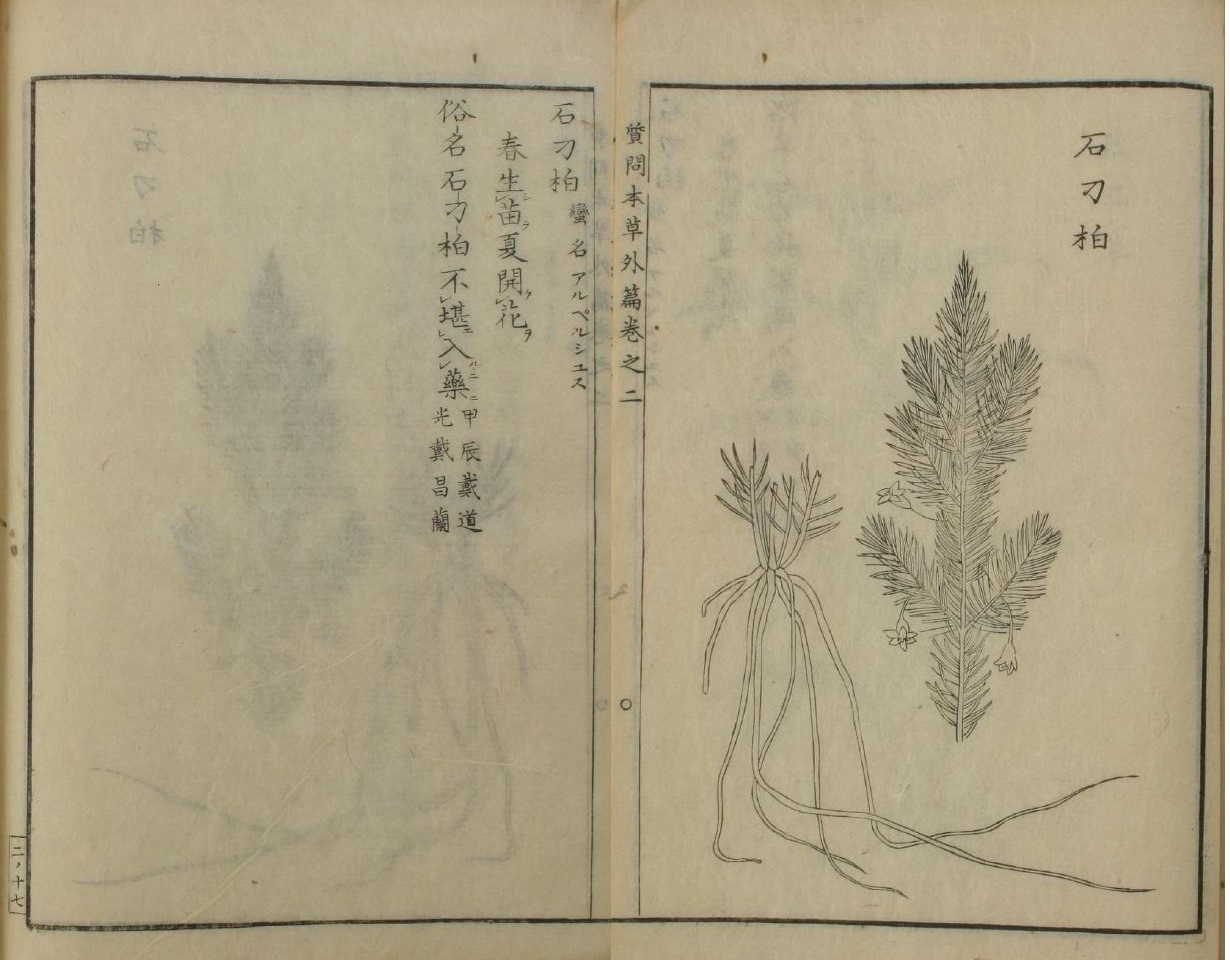
質問本草 外篇巻之二 NDL
★中山 呉子善『質問本草』は沖縄の中山および掖玖諸島の草木160種に関し,漢名や薬効を福建等の中国医師45名に質問し,その答えに基づき,草木の線描と簡単な効用を紹介している.本書は寛政元年(乾隆五十四年、尚穆王三十八年、1789年)に完成した.時の八代薩摩藩主島津重豪はこれをおおいに喜んで出版するつもりであったが,果たさないうちに死去.これを48年後に曾孫の十一代藩主島津斎彬が,天保八年(道光十七年、尚育王三年、1837年)に薩摩府學蔵版として世に出したものである.

この書の「外篇巻之二」には,
「石刁柏 蠻名アスペルシユス
春苗ヲ生シ夏花ヲ開ク
俗名 石刁柏 藥ニ入ルニ堪エ不
甲辰戴道 光戴昌蘭」
とあり,描かれた植物は,中国人医師により,漢名:石刁柏(セキチョウハク),蠻名(蘭名):アスペルシユスと同定され,薬にならないとされている.しかし,この絵を見ると,Asparagus officinalis より草丈が低く,葉が密生していて根も細い.また,「質問本草」の仕事が始まった年が,丁度オランダキジカクシが日本に渡来したとされる年で,アスパラガスが当時の琉球列島にあったとは考えにくいことから,この植物はクサギカズラやタマボウキの類と考えられる.
注目すべきは,既にこの時期に中国ではアスパラガスが石刁柏という漢名を持ち,アスペルシユスと蘭名が認識されていた事で,この時期以前に欧州から渡来し,ある程度普及していたことが伺われる.

★岩崎灌園(1786-1842)『本草図譜』(刊行1828-1844) には,野生種,園芸種,外国産の植物の巧みな彩色図が,余白に名称・生態などについて説明を付し,『本草綱目』の分類に従って配列されている.巻5-10は文政13(1830)年江戸の須原屋茂兵衛,山城屋佐兵衛の刊行.以下巻11-96は筆彩の写本で制作,三十数部が予約配本され,弘化元(1844)年に配本が完了した.
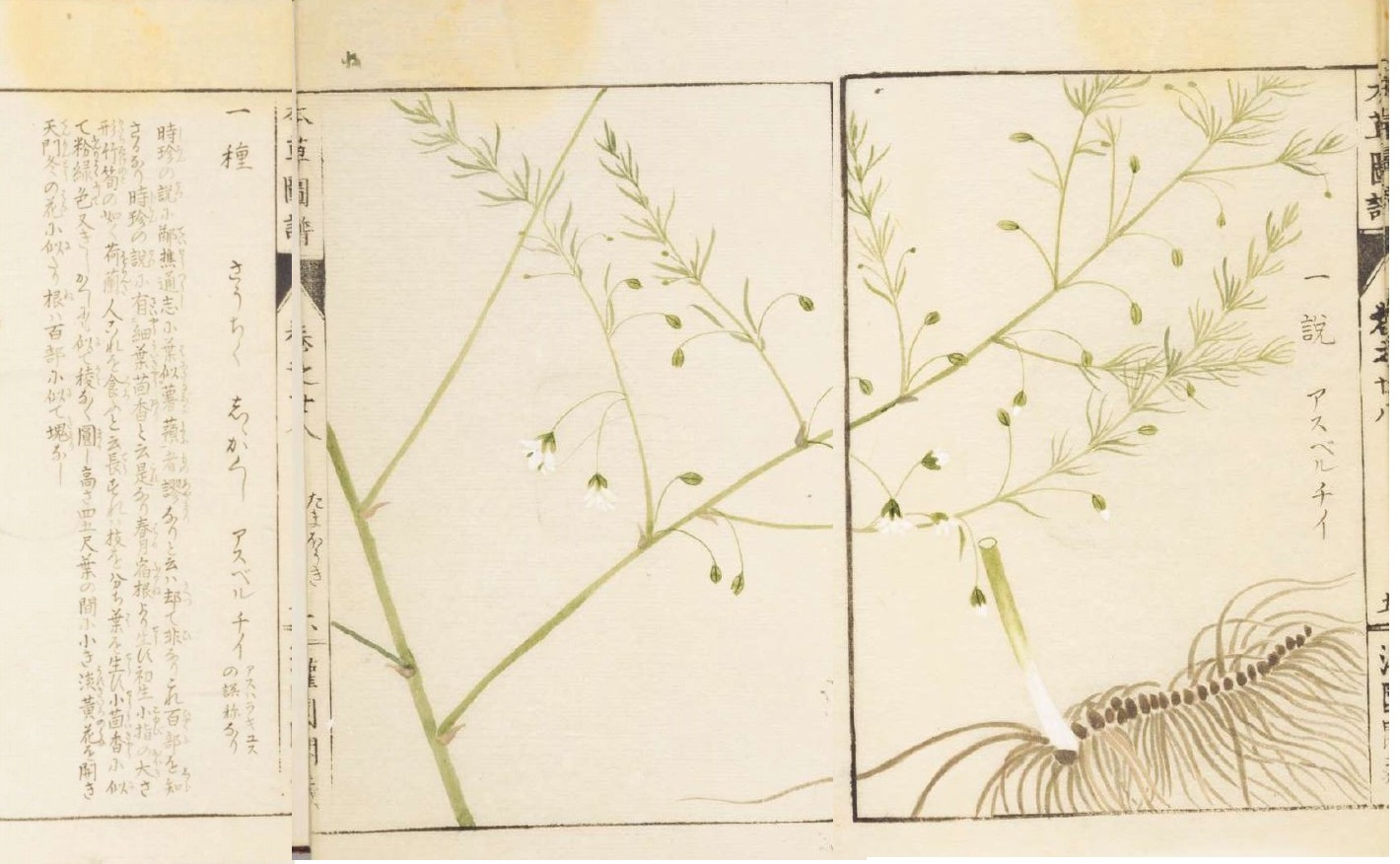
本草図譜 巻之二十八 NDL
この書の巻之二十八,「百部」の項には,
「一種
さうちく
志ヽかくし
アスベルチイ アスハラキュスの誤称なり
時珍の説に鄭樵通志に葉似薯蕷者謬なりと云ハ却て非なりこれ百部を知らざるなり
時珍の説に有細葉茴香と云是なり 
春月宿根より生ず初生小指の大サ形竹筍の如く荷蘭人これを食らふと云 
長すれバ枝を分ち葉を生じて小茴香に似て粉緑色又きじかくしに似て稜なく圓く高サ四五尺葉の間に小き淡黄花を開き天門冬の花ニ似たり 根は百部に似て塊なし.」
とある.「荷蘭人これ(小指の大きさで形が筍のような芽)を食らふと云」と西洋では食用にされていたことを認識している.また,冒頭の文は明の時珍『本草綱目』の「草之七 蔓草類,百部」の項に「(《別錄》中品)【釋名】婆婦草 野天門冬
(中略)
時珍曰︰百部亦有細葉如茴香者,其莖青,肥嫩時亦可煮食。其根長者近尺,新時亦肥實,但乾則虛瘦無脂潤爾。生時擘開去心曝之。鄭樵《通志》言葉如薯蕷者,謬矣。」とあるのを指すが,この時代中国にアスパラガスがあるとは考えにくい.

★飯沼慾斎『草木図説前編(草部)』(草部は1852年(嘉永5)ごろ成稿,出版 1856 (安政3) 年から62 (文久2) 年)草類1250種,木類600種の植物学的に正確な解説と写生図から成る. 

草木図説 巻之七 草部 第六綱下 NDL
「巻之七 草部 第六綱下
 蘭種キヂカクシ 石刁柏 質問本草
此草ハ蘭舶載來テ訛轉シテ普クアステルヒーノ名ヲ稱ス。キヂカクシ類中ノ最大ナルモノニシテ高四五尺ニ及ヒ。莖圜ニシテ線條ナク。枝撓ミテ婆娑。幹枝共ニ○?アリ。幹ニアツテハ殆ト鱗状ニシテ。ソノ下側ノ正中ニ當ツテ一尖起アリ。蓋シ刺ノ小ニシテ軟ナルモノナリ。枝ニ至テハ分裂シ両側一針様ヲナス。亦柔ニシテ剛ナラズ。葉細長針状鹹蓬葉ニ似テ細カク如糸。七九或ハ十餘モ一處ニ攅生シ。花キジカクシノ如クナレトモ。彼ノ如ク多カラズ。長梗アルコト玉ホウキノ如クシテ葉間ニ下垂ス。萼六出ニシテ短小。花六辧尖纔(ワズカ)ニ開翻シ。色淡黄緑白。六雄蕋辧瓜ニ出。實礎六縦道アル圓体ニシテ種ナケレバ。斷シテ假トス。此種詰實セズソノ雄性ナルコト不待言 附一 全花
一 陪圖 二 開花体見諸事郭大圖
第二種 アスパラギュス デシリナトュス  アフゲホーゲ子 アスペルギー 蘭
     Asparagus Declinatus            afgeboogene aspergie」

とあり,黒白ながら美しく精密な木版画と共に,雌雄別株の存在など正確な観察の結果が記載されている.


2016年1月18日月曜日

アスパラガス-3 共和政-帝政ローマ時代 大カト,コルメッラ,パッラディウス

Asparagus officinalis
2004年6月
地中海沿岸原産と考えられるアスパラガスは,古代ギリシャから野生種の若い芽が食材として利用され,ローマ時代には,農民が現在と同じ種を大がかりに栽培していたと考えられる.栽培法は幾つかの農書に収載され,太く柔らかな芽を得うるために,湿度の高い肥沃な土地が栽培に適しており,アシとの共作や,播種・中耕・除草・施肥などの方法が細かく指示されていて,重要な換金作物として認識されていたことがうかがえる.

共和政後期の著名な雄弁家であり監察官でもあった★マルクス・ポルキウス・カト・ケンソリウス(大カト,Marcus Porcius Cato Censorius, 234 B.C.-149 B.C.) の『農業論,デ・アグリ・クルトゥラ (De Agri Cultula)』には,畑での栽培法が細かく記載されている.
(英訳W. D. Hooper et H. B. Ash, Loeb Classical Library, London (1934),和訳はこれより私訳)
161 Method of planting asparagus: Break up thoroughly ground that is moist, or is heavy soil. When it has been broken, lay off beds, so that you may hoe and weed them in both directions without trampling the beds. In laying off the beds, leave a path a half-foot wide between the beds on each side.
Plant along a line, dropping two or three seeds together in a hole made with a stick, and cover with the same stick. After planting, cover the beds thickly with manure; plant after the vernal equinox. When the shoots push up, weed often, being careful not to uproot the asparagus with the weed.
161 アスパラガスの栽培法 湿ったまたは粘土質の土をよく耕す.苗床に踏み入らず,両側から雑草をぬき,鋤き返しが出来るように苗床を作る.苗床を作るにあたっては,半フィートの幅の道を両側に作る.一直線上に杭で穴をあけ二,三粒ずつ一緒に入れて播き,同じ杭で覆土する.種播きは春分の直後に行ない,その後苗床を厚く肥料で覆う.発芽後は,雑草と一緒にアスパラガスを引き抜かないように注意して,頻繁に除草する.
The year it is planted, cover the bed with straw through the winter, so that it will not be frostbitten. Then in the early spring uncover, hoe, and weed.
The third year after planting burn it over in the early spring; after this do not work it before the shoots appear, so as not to injure the roots by hoeing. In the third or fourth year you may pull asparagus from the roots; for if you break it off, sprouts will start and die off. You may continue pulling until you see it going to seed. The seed ripens in autumn; when you have gathered it, burn over the bed, and when the asparagus begins to grow, hoe and manure.
種を播いた最初の年には,冬の間は床を藁で覆って霜の害から守り,早春に覆いの藁を取りはらい,土を鋤き返し,除草する.
三年目の早春には,覆いの藁を燃やす.この後はアスパラガスの芽が出ないうちは,アスパラガスの根を痛めないよう,鋤き返しの作業をしてはいけない.三年目四年目には,アスパラガスを根元から収穫できる.途中で折ると,新芽が発生して枯れてしまう.種をつけるようになるまでは収穫し続けることができる.秋に種が熟したら,集めて床の上で燃やし,アスパラガスが生育するに従い,鋤き返して肥料を施す.
After eight or nine years, when it is now old, dig it up, after having thoroughly worked and manured the ground to which you are to transplant it, and made small ditches to receive the roots. The interval between the roots of the asparagus should be not less than a foot. In digging, loosen the earth around the roots so that you can dig them easily, and be careful not to break them. Cover them very deep with sheep dung; this is the best for this purpose, as other manure produces weeds.
そして八・九年後,すっかり古くなってしまったら,(新しい場所の)土をよく耕して肥料を施してから掘り上げ,小さな溝を作って,そこに株分けする.その根を一フィート以下の間隔で植える.掘りだす際には容易に掘り出せるように,根の周囲の土をやわらかくし,折らないようにすることが肝要である.(株分けした根は)ヒツジの糞で上を厚く覆う.この目的には羊の糞が最適である.というのは,他の動物の堆肥では雑草が生えるからである.

L. JUNIUS MODERATUS COLUMELLA
from Wiki-commons public domain 
帝政ローマ時代のもっとも重要な農書の著作者★コルメッラ (Lucius Junius Moderatus Columella; 4 – c. 70 AD) の12巻よりなる ”Res rustica(農業書)” は完全な形で保存されていて,ローマ帝国の農業を理解する上によい資料であり,後世のPliny the Elder に引用されている.無記名者に英訳された完本が1745年に出版された.和訳はこれよりの私訳.
“L. JUNIUS MODERATUS COLUMELLA 0F HUSBANDRY. IN TWELVE BOOKS: AND HIS BOOK CONCERNING TREES.
Translated into English, with several Illustrations from Pliny, Cato, Varro, Palladius, and other antient and modern AUTHORS.
この書では数カ所で Asparagus に言及しているが(Book X: p444, 570「(初夏に)つやつやとしたにアスパラガスの芽がでる」, Book XI: p488 「二月にアスパラガスを植えたり種を播いたりする」),特にBook XI の Chap. III. p 493に詳しい栽培法が載っている.

Chap. III.
About the first of October, chervil, as also the pot-herb orrach, which the Greeks call ασπάραγος must be put under-ground, in a place that is not very cold: for, it the country has very hard winters, the plants must be transplanted from the place where they were seated close together, and separated to a greater distance the one from the other. The same method is observed in the sowing of poppy and dill, as of chervil and orrach.
 The seeds of garden asparagus, and of that which the peasants call corruda (wild asparagus) are almost two years in preparing : when, in a fat and well-dunged soil, you shall have put them under-ground, so as to place into every little trench you have made for them, as much seed as your three fingers can hold ;
十月の始めに(中略)庭用アスパラガスと,農民たちがコルードと呼ぶ野生のアスパラガスの種を播くが,収穫?までは殆ど二年かかる.肥えてよく肥料が施された土壌では,三本指でつまめるほどの量の種を,そのために作ったそれぞれの溝の中に播いて上に土を十分にかける.

commonly after the fortieth day they are twisted and interwoven with one another, and make, as it were, an unity, or one united mass ; which small roots, thus twisted and connected, the Kitchen-gardeners call spunges : and it is proper, that, after twenty-four months, they be transplanted into a sunny place, sufficiently moist, and well dunged : but the trenches or furrows are made at the distance of one foot the one from the other, and not more than three- fourths of a foot in depth, into which the little spunges are so thrust down, that, after the earth is put upon them, they may easily spring up.
通常四十日ほどで,それらはよじれ互いに絡まりあい,そうであった様に一本になって一つの塊になる.その小さな根は捩れて繫がりあう.野菜を育てる園芸家はこれを「スプンゲ (spunge)」と呼ぶ.適切に育てられると,二十四ヵ月後に,日当たりのよく,湿潤で,よく施肥された場所に移植できる.しかし溝や畦は互いに一フィートは離し, 3/4フィートの深さにすべきであり,そこに土をかけた後で容易に芽が出るように小さな「スプンゲ (spunge)」(の芽)を押し込む.


But, in dry places, the feeds or plants must be placed in the lower parts of the furrows, that they may abide, as it were, in little chanels or troughs : but in such as are ousy*, on the contrary, they must be placed in the uppermost back of the ridge, lest they be hurt with too much moisture.
しかし乾燥した土地においては,播種と地植えは(畦と畦との間の)低い部分にすべきであり生育もその場所でよく,小さな水路や水溜りでも同様である.しかしこれに反し,ヤナギと同様に水分があまりにも多い土地では過剰の湿度で害を受けることのないように畝の最上部に植えるべきである.

Then the first year, after they have been thus planted, the asparagus, which they shall send forth, must be broken off short ; for if you should pull it up from the bottom, the little roots being as yet tender and weak, the whole little spunge will follow : the rest of the years it must not be cropped, but plucked up by the root ; for, unless you do so, the stalks that are broken off short, hurt, and give pain to the eyes of the spunges, and, as it were, blind them, and do not suffer them to put forth the asparagus.
このようにして植えられた最初の年には,アスパラガスの出てきた芽は短く折り取らねばならない.もし,根元から引っこ抜いたら,まだ柔らかく弱い小さな根が若い「スプンゲ (spunge)」全体が続いて(抜けて)くるからである.その年の残りは収穫はせず,根の周りの除草を行なう.そうしないと莖が短く折られ,損じられ,(次の年芽の出る)「スプンゲ (spunge)」の目(eye)に損傷を与えるからである.そのようであるなら,目か潰されていて,アスパラガスを発生しない.

Moreover, every stalk, which springs up last in Autumn, must not be intirely taken away, but some of them must be left, and set apart for seed. Then, after it has made its prickle, the feeds themselves being gathered, the haulm must be thoroughly burnt in its own place, just as it is ; and then all the furrows must be sarcled, and raked at the same time, and the weeds taken out of them ; and presently after, either dung or ashes thrown into them, that the juice of them, trickling down with the rains the whole Winter, may come to the root.
Then in the Spring, before it shall begin to sprout, let the earth be stirred with a forked irontool, that the style may the more easily spring up, and shew itself, and become thicker and fuller when the ground is loosened.
更に前年の秋に伸びた全ての莖を全部取り去ってはいけない.何本かは種を取るために別にしておかねばならない.刺(状の葉)を茂らせ,種を集めた後, haulm をその場所でそのまま完全に燃やし,全部の(畝と畝との間の)溝の除草を行い,同時に(熊手で)かき集め,雑草を完全に除く.冬の間に降る雨によって滴り落ちた抽出液が根に届くように,その直後に堆肥か灰を溝に投入する.
春になったら,地面が融解したときに,若芽がより容易に出てきて姿を見せ,太く,充実しているように,芽が出る前に,地面を鉄製のフォーク(またぐわ)で掻き回す.

★パッラディウス(Palladius Rutilius Taurus AEmilianus)は紀元後4–5世紀に活躍したローマ時代の著述家で,特に14巻からなる『農業』(Opus agriculturae, sometimes known as De re rustica)でよく知られている.この書にもアスパラガスの栽培についての記事があり,ここでも湿地でアシと一緒に栽培する利点が述べられている.

THE FOURTEEN BOOKS OF Palladius Rutilius Taurus AEmilianus, ON AGRICULTURE, translated into English By T.OWEN, M. A. et. al. LONDON: J. WHITE (1807).(和訳はこれよりの私訳)
BOOK III. FEBRUARY. (二月の農作業)
XXIII. OF PLANTATIONS OF REEDS AND ASPARAGUS, AND OF THE PLANTS OF WILLOWS AND BROOM, AND OF MYRTLE AND LAUREL NURSERIES.(アシとアスパラガスの畑について,また,ヤナギとエニシダ,及びミルテとゲッケイジュの育種について)

'Reeds are to be planted at this season in very small trenches; the eyes of the reed being set in all the trenches, which ought to be at the distance of half of a foot from each other. If we consult the advantage of a warm and dry province, we must allot wet vallies, or such as are well watered, to the reed plantations. If the country is cold, let them be raised in mode- rate situations, but in such as lie to receive the moisture of the villa yard. We may sow the seeds of asparagus among these, that they may grow together, because asparagus is cultivated and and burnt in the same manner as the reeds. If the plantations are old, let them be weeded at this season, those parts being cut off, which are to be cleared from the root; that is, those shoots that are decayed, and such as have no eyes for propagation. We are now to set the plants of willows, and of all such kinds as are to be applied to the use of the arbustum, or broom, if it is wanting. We are also to set myrtle and laurel-berries in nurseries, or if they are already set, we are to trim them. - - -
アシはこの季節(二月)に非常に小さな(浅い?)溝に植えるべきである.アシの芽がでる部位(eye)は互いに半フィートはなれた距離で溝に置く.もし暖かい乾いた地方を利用するならアシの畑のためには,谷やそのようなよく水が得られる土地を使うべきである.寒い地方において栽培する場合には,やや温和な環境で,しかし別荘の庭の湿度を受けるようなところに置いて育てるようにする.我々はアスパラガスの種をその間に播種し,共に育てることができる.というのも,アスパラガスはアシと同じように栽培され,燃やすことが出来るからである(灰は肥料となる).畑が古くなった場合には,この季節に根元からきれいにするために抜き,切断する.なぜなら,これらの芽は壊れており,繁殖のための芽がでる部位eye を持っていないからである.そこで,(この後に)我々はヤナギを植える. arbustum, or broom,(エニシダ,箒に使う)が必要とされている場合には,これら全ての種類の栽培法が適用できる.(この季節)ミルテとゲッケイジュの苗を植えるし,既にある場合は剪定する.(以下略)

2016年1月12日火曜日

アスパラガス-2 古代ギリシャ テオフラストス,共和政ローマ ウァロ

Asparagus officinalis
2004年5月
地中海沿岸原産と考えられるアスパラガスは,古代ギリシャから野生種の若い芽が食材として利用され,ローマ時代には現在と同じ種が広く栽培されていたと考えられる.

現存する最古のヨーロッパの植物書とされている古代ギリシャの著作家★テオフラストス(Theophrastos, 英: Theophrastus, 371B.C – 287B.C.)の『植物原因論 (Enquiry into plants, and minor works on odours and weather signs)』には,アスパラガス (ασπάραγος) について,この植物の葉の特異な形状について,複数回述べ,さらに (4) では,春には根から茎が出てきて,それが食用にされること,細い刺のような葉の根元から小さな蕾と花が着くこと,を記している.

(1) I. x. 6-8 “For in all these spines, as it were, take the place of leaves, and, if one is not to reckon these as leaves, they would be entirely leaves, and some would have spines but no leaves at all, as asparagus.”
(2) VI. i. 2-3 “ Of spinous kinds some just consist of spines, as asparagus and skorpios ; for these have no leaves except their spines.”
(3) VI. iv. 1-3 “Of the classes thus distinguished that with spinous leaves is the largest, while that which is altogether spinous is about the smallest. It is indeed, as was said, a very small class, and it would not be easy to find examples of such plants besides asparagus and skorpios.(中略)Both of these flower after the autumnal equinox. Skorpios produces its flower in the fleshy swelling below the top of the spinous twig ; at first it is white, but afterwards it becomes purplish. Asparagus produces alongside of the spines a small knob, and from this grows the flower, which is of small size.”
Skorpios has a single root which runs deep; asparagus roots very deep and its roots are numerous and matted, the upper part of them being in one piece, and from this the actual shoots spring. The stalk comes up from the plant in spring and is edible; afterwards, as the season advances, it acquires its rough and spinous character ; the bloom appears not only on this stalk, but on those of previous years, for the stalk is not annual. Such is the character of plants which are altogether spinous.
(“Theophrastus: Enquiry into plants, and minor works on odours and weather signs, with an English translation” by Sir Arthur Hort (1864-1935), The Loeb Classical Library; London: G. P. Putnam's Sons,1916.” )

『テオプラストス 植物誌 2』小川洋子訳 西洋古典叢書 京都大学学術出版会 (2015)
第六巻 小低木,特に花冠用植物について
第一章 小低木の分類
三 刺のある植物の中には,アスパラガスや,「スコルピオス(サソリ草)」(ノハラヒジキ)のように,刺だけを付けていて,刺以外に,どんな葉も付けていないものもあれば,刺のある葉を付けるものもある.
第四章 刺のある小低木(続き)-刺がある部分による分類
アスパラガスや「スコルピオス」(ノハラヒジキ)以外,このような植物(*全体に刺のある植物)の例を見つけるのはなかなか容易ではない.
二 両者はともに秋分の後,花を咲かせる.
「スコルピオス」(ノハラヒジキ)は,刺の付け根のところ「葉腋」で膨らんだ,肉質の部分に花を付ける.花ははじめ白く,後に赤味がかっだ色になる.アスパラガスは刺のそばに小さなこぶ状の芽のようなものを作り,ここから小さな花が出てくる.「スコルビオス」は一本の根を深く伸ばす.一方アスパラガスは,確かに根は深いが数が多く,根〔根茎〕が密生しているので,その上部はひと塊になっている.そこから,茎そのものの芽が出てくる.春になると,アスパラガスの根〔根茎〕から茎〔鱗芽のある吸枝〕が出てきて,それが食用にされる.その後季節が進むにつれ,茎はざらつくようになり,刺状になる.茎が一年生ではないので,花はその年に生えた茎だけでなく,前年の茎にも付く.

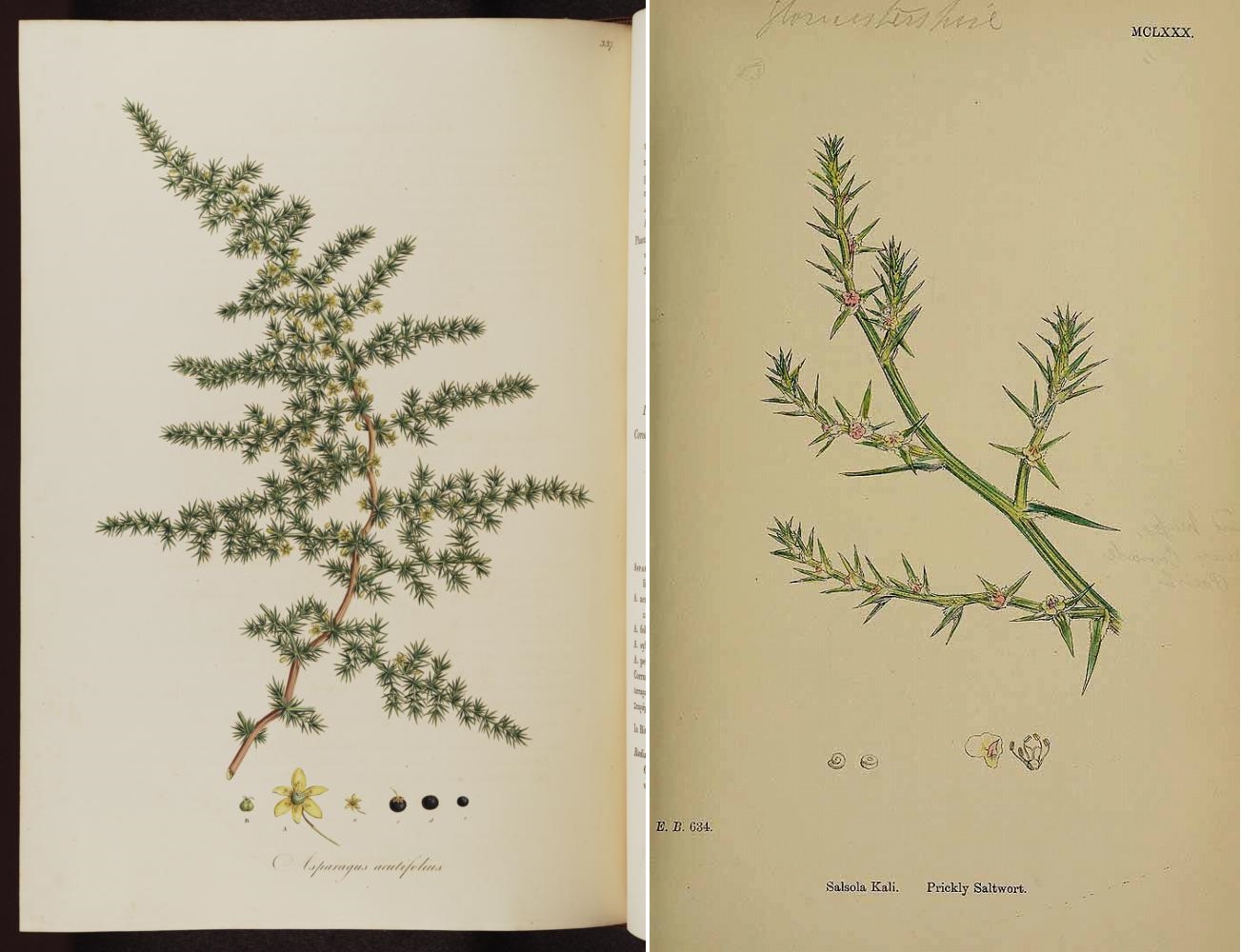
最初の文の英訳者 Hort は,この Asparagus を Asparagus acutifolius  (Wild asparagus) と,また,Robert W. Sharples は skorpios を,細かく切れ込んだ葉と黄色い花をつけるトリカブトの類,Aconitum anthora と考定している.一方,小川洋子が訳書の底本としたアミグ (Suzanne Amigues, 1937- ) の "Theophraste, Recherches Sur Les Plantes" では,これをアカザ科オカヒジキ属の Salsola kali (S. tragus. 標準和名 ハリヒジキ) であるとした.植物図譜を見ると,花色など,こちらの方がテオフラストスの記述に合っている.
 左図:Asparagus acutifolius, Sibthrop, J. Flora Graeca (drawings), vol. 4: t. 37 (1823)
 右図:Salsola kali : Woodville, Medical Botany, 3th edition, vol. 4: t. 227 (1832)

アスパラガスは古代ローマ時代には食用として大規模に栽培されたようで,
★マルクス・テレンティウス・ウァロ(ラテン語: Marcus Terentius Varro, 紀元前116年 - 紀元前27年)は,共和政ローマ期の学者,著作家,政治家である.「レアテのウァッロ」(ウァッロ・レアティヌス,Varro Reatinus)とも称される.ウァロは大量の作品を残していて,フリードリヒ・ウィルヘルム・リッチェル(en:Friedrich Wilhelm Ritschl)によれば,74の作品,約620巻を記したと推測されているが,そのうち完全な形で残っているのは『農業論』1つしかない.(英訳:Varro on farming = M. Terenti Varronis Rerum rusticarum libri tres / translated by Lloyd Storr, Bohn's classical library (1912),和訳はこれより私訳)

“Rerum rusticarum libri III(農業論 3巻)
CHAPTER XXIV OF OLIVES, AND TREE PLANTING p67
4. Scrofa added on the same authority that if the place be damp you should plant there shoots of poplar trees and make a reed plantation. It is first dug with a large spade, and then the eyes of the reed are planted at intervals of three feet [and with them wild asparagus, that the garden variety may result from it]. Both asparagus and reeds need pretty much the same kind of treatment. Osiers should be planted round the reed bed, to provide material for tying up the vines.
スクロファは専門家として,その土地が沼地ならポプラを植えてアシの畑にすべきだと付け加えた.最初に大きな鋤で掘って,芽を出す部位(eye)を持ったアシを三フィートの間隔で植える.〔それと共に,庭のアスパラガスが由来した野生のアスパラガスも植える〕.アスパラガスとアシは全く同じような手入れが必要である.オジャー(枝のしなやかなヤナギ)もアシの畝の周りに植えるべきである.そうすると蔓(ブドウの木?)を縛る材料が得られる.

* Gnaeus Tremellius Scrofa,: アウグストゥス帝(紀元前63年- 紀元14年)時代の重要な農学者・著作家.その著作は現存していないが,後の農学者たちによってしばしば引用される.
** オジャー osier: Salix viminalis, the basket willow, common osier

続く